The Oregon Alligator Lizard and his Food Web

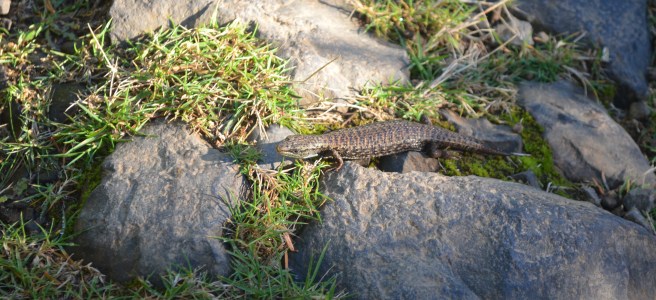
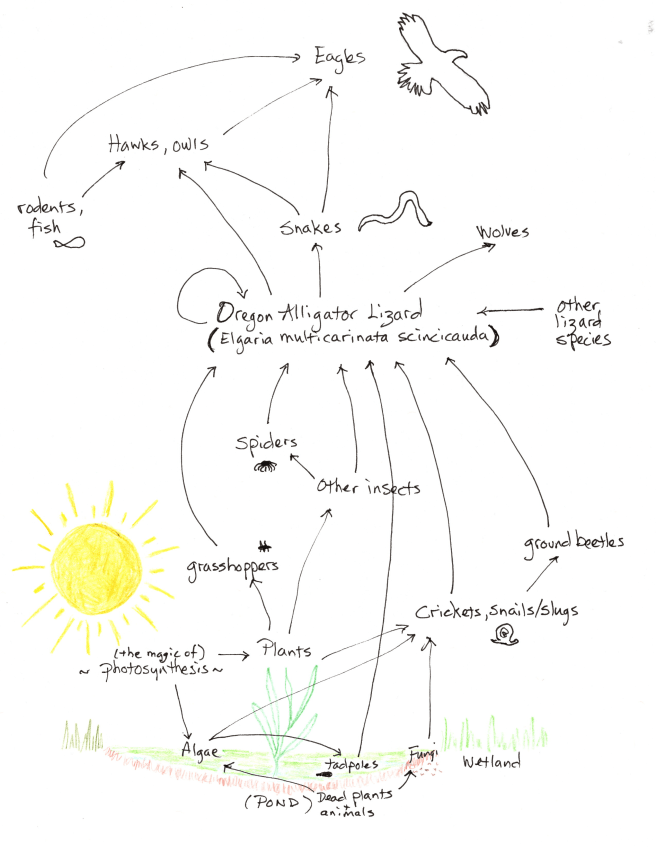
Several years ago my son came home from a hike and shared with me a picture of a lizard he found. After a bit of quick detective work we identified it as an Oregon Alligator Lizard (Elgaria multicarinata scincicauda). Coincidentally, I was engaged in doing coursework to become an Oregon Master Naturalist. We were currently studying the Fundamentals of Ecology and were given an assignment to create a food web for any given species. What you see below is the food web I created for the Oregon Alligator Lizard.
DEFINITIONS:

  • Food Chain: A linear system showing a succession of organisms whereby each species is eaten in turn by another species.
  • Food Web: A graphic model showing many food chains linked together to depict the feeding relationship of organisms in an ecosystem.
  • Apex Predators: The predator at the top of a food chain that is not preyed upon by any other animal.
  • Keystone Species: A species that has a large impact on its environment relative to its abundance. It plays a critical role in a food web by determining the types and numbers of various other species in the ecosystem. Without the keystone species, an ecosystem would be drastically different or collapse. Keystone species are sometimes, but not always, apex predators.
  • Trophic Levels: Describes the hierarchy in a food web which groups organisms based on the same number of steps removed from the primary producers.

The Oregon Alligator Lizard is a subspecies of the Southern Alligator Lizard (Elgaria multicarinara). It is a reptile native to the Pacific Coast of North America from Washington state to Baja California. This species has adapted to many diverse habitats however it is partial to foothill oak woodlands. Although it is listed by the IUCN Red List as “least concern” it is still a declining species due to habitat loss. It is carnivorous and feeds on a wide variety of prey — basically anything it can get it’s mouth on. They are also known to be cannibalistic, eating their own young, or adult males and females eating each other. This has been demonstrated in my food web diagram by the arrow going from and pointing to the lizard.

Cannibalism is an interesting, if somewhat disturbing, ecological interaction between species. It has been recorded in more than 1,500 species. Not unexpectedly, cannibalism increases in environments where other usual food sources are not meeting the needs of individuals. However, there are other reasons why individuals of a species may turn to cannibalism: as a way to regulate population numbers and increase access to necessary resources (shelter, territory, food), and increased mating opportunities. A feedback loop occurs when cannibalism decreases a species population density to the point where it becomes more beneficial to forage in the environment for other food sources than for cannibalism to occur.

A food chain refers to a succession of organisms in an ecological community where each organism is dependent on the next as a source of food. The basic food chain for the Alligator lizard would look like this:

Hawk —> Snake —> rodent —> Alligator lizard —> cricket —> vegetation

A food web is made up of a complex of interconnected food chains. Organisms in a food web are grouped into trophic levels. The basic trophic level categories are Producers, Consumers, and Decomposers.

Producers, or autotrophs, make up the first trophic level — they make their own food and do not depend on other organisms for nutrition. In my food web example, the plants and algae are the autotrophs.

Consumers are categorized as follows:

  • Primary consumers are herbivores (plant eaters). They are considered to be at the second trophic level. In my food web the insects, tadpoles, and snails/slugs are part of the second trophic level.
  • Secondary consumers eat herbivores. They are at the third trophic level. In my food web, the spiders, alligator and other lizards are part of the third trophic level.
  • Tertiary consumers eat secondary consumers. They are at the fourth trophic level. In my food web, the snakes, wolves, hawks and owls are in the fourth trophic level.
  • There may be additional trophic levels of consumers before a food chain reaches it’s top predator — the apex predator. Apex predators have no natural enemies except humans. In my food web, the eagle is the apex predator.

Decomposers complete the food web by eating non-living plant and animal remains. They turn organic waste into inorganic material thereby returning nutrients to the soil or ocean for use by autotrophs to begin a new food chain. In my food web, the fungi, algae, and ground beetles are all decomposers. Beetles are actually considered both consumers and decomposers.

It makes sense to think of a food web as it relates to an ecosystem. Some examples of ecosystems include a forest, desert, marine, tundra, grassland, coral reef. My food web example would be part of a freshwater ecosystem. Food webs are defined by their collective biomass, or the available energy in the living organisms. The web’s biomass decreases with each trophic level; there are more autotrophs than herbivores, more herbivores than carnivores, and relatively few apex predators. This allows the ecosystem to remain in balance and recycle biomass.

Every link in a food web is connected to at least two others. When one link in the food web is broken, particularly if there is a decrease or extinction of a keystone species, the entire food web is weakened or may collapse all together. Habitat loss is often a culprit in the weakening of food webs. Consider the decline in the salmon populations over that past few decades. One of the main reasons for this decrease is the loss and degradation of habitat from dam construction, stream pollution, lack of shade trees and woody debris in streams, over-irrigation, etc. With less salmon available, bears are forced to turn to other available food sources like ants. Since ants are decomposers, fewer ants means fewer nutrients returning to the soil which can support fewer autotrophs.

MAKING THE CONNECTION:

Once you have an understanding of how interconnected various species are simply on the level of who-eats-whom, and the necessary components that keep this cycle in balance, it becomes easier to understand why biodiversity is important to all life on earth. All life is dependent on the availability of water and nutrients to sustain a given organism. Humans, in general, have lost their intimate connection to the land and the importance of caring for the other beings we share the planet with. The ease of a quick drive to the grocery store has disconnected us from the understanding of how the foods found within were produced — what beings gave their lives so that we can eat and continue our own existence? Every meal should be taken in gratitude and commitment to ensure the harvest is sustainable. We depend on healthy ecosystems for our long-term survival.

Note: To comment on this post, click on the post title and scroll to the bottom of the page

REFERENCES:

https://www.nationalgeographic.org/encyclopedia/food-web/

https://ielc.libguides.com/sdzg/factsheets/southernalligatorlizard/summary

https://en.wikipedia.org/wiki/Cannibalism

https://www.fws.gov/salmonofthewest/poorhabitat.htm

https://extension.oregonstate.edu/mn

.
Trees and their Fungal Friends

The relationship between plants and fungi is a very old story. Plants were able to move from water to land about 400 million years ago because of their relationship with fungi which served as their root systems until they evolved to develop their own roots. Millions of different fungal species inhabit the earth and a majority of these dwell in the soil.  Soil fungi are grouped into 3 categories: decomposers, mutualists, and pathogens. In this article, we are only looking at the mutualists; specifically, the fungal species that have adapted to live communally with trees where both tree and fungi benefit from establishing a relationship.

DEFINITIONS:

  • Hyphae — individual fungal threads, usually between 1-10 thousandths of a millimeter in diameter. A single hyphae can grow up many meters long.
  • Rhizomorphs –—an aggregation of hyphae intertwining like strands of a rope making a “root-like” structure.
  • Mycelium — The thallus, or vegetative part, of a fungus made up of a mass of branched hyphae. Mycelial networks can extend over tens or hundreds of meters.
  • Mycorrhiza — a mutual, symbiotic relationship between a fungus and a plant, unlike either fungi or roots alone.
  • Symbiotic relationships — Broadly defined as relationships occurring between living entities. Although there are several types of symbiotic relationships, for this story, we are looking at one subtype: mutualistic symbiosis.
  • Ecosystem — A community of living organisms in conjunction with the nonliving components of their environment, interacting as a system.

Trees thrive when they live together in a forest. A single tree will struggle to survive on its own, however many trees together create an ecosystem that produces a protective environment in which the trees can live to be very old. Since every tree is a valuable member of the community, trees have developed several ways to support and nourish each other. This is true for trees of the same or different species. There are several ways trees communicate and nourish each other above ground, however we are going to focus on how they do this underground.

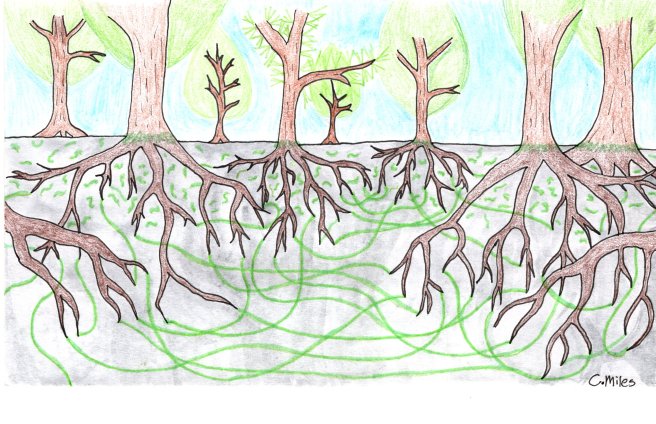
Indigenous peoples have long understood that trees communicate with and nourish each other. Only recently have scientists used modern tools and techniques to explain just how this amazing communal network occurs. The most important means of underground communication is by participation in a mycelia fungal network — the relationship between tree roots and the fungal hyphae present in the soil. These hyphae form networks known as mycelium which infiltrate and connect tree roots of the same or different species. Over centuries, a single fungus can cover many square miles and network an entire forest, enabling the sharing of water and nutrients. The mycelial network can also transmit very low voltage electrical impulses to trees which communicates information about insects, drought, and other dangers. This vast underground mycorrhizal network can be thought of as the “internet” of the soil and is often referred to as the “wood wide web”.

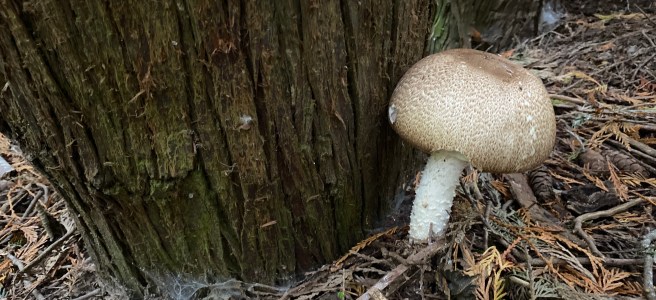
Another service fungi provide trees is the filtering out of any heavy metals in soil. These diverted pollutants turn up in the fungi’s fruiting body (i.e. mushrooms). Fungi will ward off bacteria or other destructive fungi that are trying to invade the tree. This tree/fungi relationship can go on for hundreds of years, however if conditions in the environment become unhealthy, the fungi may die out. At that point the tree may hook up with a different fungal species that settles in at its feet. Every tree species has multiple options for mutualistic fungal partners.

I’ve focused above on the benefits a tree derives from its relationship with a fungal partner however, as I mentioned, this is a mutualistic partnership. What is the benefit for the fungi?

Payment for the services the fungi provide to the trees is in the form a nutrition – sugar and other carbohydrates – which the fungi cannot produce on their own. The fungi retain about 30% of the carbohydrates the tree produces, thank you very much.

Some species of fungi are considered “host specific” and will partner only with a specific tree type (e.g. birches or larches). Others, like chanterelles, get along with many different tree types. Underground competition is fierce which works to the benefit of the trees; it is only when all the fungal species die out that the tree becomes vulnerable. Because fungi are dependent on stable conditions, they support a variety of species in order to ensure that one tree species doesn’t manage to dominate. Fungi can store and later share resources (particularly nitrogen and phosphorous) when the soil becomes depleted. In some tree/fungal relationships where the soil becomes depleted of nitrogen, the fungi will release a deadly toxin into the soil which causes minute organisms such as springtails (tiny insects that live in leaf litter, compost piles, and soils) to die and release nitrogen tied up in their bodies, forcing them to become fertilizer for both the tree and the fungi.

Saplings (young trees) growing in a shady area that do not receive enough sunlight to perform adequate photosynthesis often receive assistance from older established trees called “hub trees” or “mother trees” to provide water and nutrients via the mycorrhizal network. Studies have shown that trees can recognize the root tips of their relatives and favor them when sending nutrients. Through the mycorrhizal network, hub trees detect distress from their neighbors and send them needed nutrients. During a recent walk in the coastal forest south of Coos Bay, Oregon I came upon the tree pictured below. I was reflecting on the tortured life this tree must have lived when I look up at the canopy and was amazed to see branches that still had green fir needles — it was still living! Further inspection led me to realize that tree next to it (in the far left of the picture) had a huge root leading right to the crippled tree, most likely providing the nutrients needed for the older tree to remain alive. Quite possibly this younger tree is the offspring of the older tree and demonstrating that both older and younger trees take care of each other as needed.

MAKING THE CONNECTION: People are generally aware of the many benefits trees provide to the natural world including removal of carbon dioxide from the atmosphere, production of oxygen, provision of shade and habitat for numerous species, wood and fruit production, to name just a few. It’s easy for humans to take for granted the gifts that trees provide to our ecosystems. Having a deeper understanding of how trees are able to grow and thrive in community with the help of their fungal friends helps foster greater respect and gratitude for both of these species. Although the mycelial network is largely invisible to human awareness, knowing of its existence and the important role it plays in nurturing our forests is an important connection to make in understanding how symbiotic relationships between species are crucial to maintaining balance in natures ecological processes.  Try to imagine a world without trees. It would be a world vastly different from the one we live in — one devoid of most, if not all, terrestrial life forms.

FURTHER READING AND REFERENCES:

Wohlleben, Peter. The Hidden Life of Trees: What they Feel, How they Communicate. 2015. Germany: Random House GmbH.

Kimmerer, Robin Wall. Braiding Sweetgrass. 2013. Canada: Milkweed Editions.

https://www.nrcs.usda.gov/wps/portal/nrcs/detailfull/soils/health/biology/?cid=nrcs142p2_053864

https://www.arboristnow.com/news/mycorrhizae-my-favorite-kind-of-fungi

https://preservationtree.com/blog/how-mycorrhizal-fungi-help-trees-communicate

https://sciencing.com/symbiotic-relationship-8794702.html

https://www.nationalforests.org/blog/underground-mycorrhizal-networkhttps://www.scientificamerican.com/article/a-poetic-mind-bending-tour-of-the-fungal-world/

Welcome!

Welcome to my blog. Come on in, grab your favorite beverage, make yourself comfy. My goal in writing this blog is to introduce you to some of the symbiotic relationships found in the natural world that may surprise and delight you. All life is dependent on symbiotic relationships between species. Understanding the interconnectedness found in the natural world will hopefully lead to an understanding of the importance of the earth’s biodiversity and inspire you to set forth on your own path to help nurture and protect our precious ecosystems. Although this topic has the potential to go many directions, and dive quickly into complexity, I keep the relationships presented limited to two or three species or subjects in one post. In order to verify the accuracy of information presented I seek out several reliable sources of information.

I have B.S. degrees in both Geology and Medical Technology and although my working career was in Medical Technology, I have always held a deep interest in the natural world which has propelled me to investigate, observe, contemplate, and appreciate the finely tuned choreography of the natural world. In 2017 I became certified as an Oregon Master Naturalist in order to learn more about the ecosystems in Oregon and to join in the efforts of various local organizations to preserve and protect our natural areas. This blog serves to educate and further inspire both of us.

I acknowledge that you, the reader, may or may not have a scientific background or training, however I make no assumptions that you are familiar with scientific terms that are not in our common vocabulary. You will see that I include a section to define terms, as needed, to help with overall understanding of the discussion. I will also include reference links for those that want to read further on the information presented.

I hope you enjoy reading this blog as much as I will enjoy writing it. Please click the “Follow NATURAL CONNECTIONS” button at the bottom of the page and share the site with anyone you think may be interested in reading the posts. I welcome your feedback and ideas for topics to include in future posts in the comments section.

Carole