
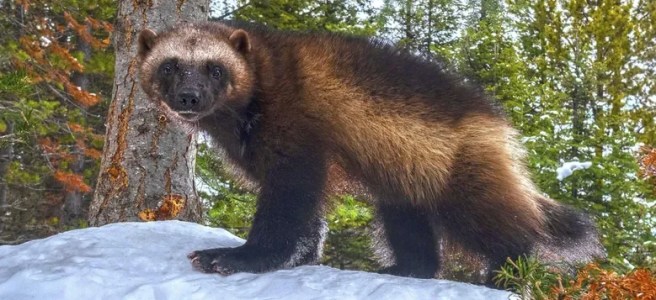
Chances are, neither you nor I will ever meet a wolverine in the wild. Some people are simply unaware of their existence, maybe having heard their name at one time, but haven’t been curious enough to investigate who this particular creature is that shares our earth home. Let’s pull back the curtain a bit and come to know something about this remarkable creature and the challenges they face in this world, thanks to the countless hours of tracking and observations made by many intrepid researchers.
I’ve come to know the facts I’m sharing about Wolverine through the efforts of a small handful of intrepid wildlife biologists who have spent years tracking and studying this amazing creature in Glacier National Park. Their work is chronicled in The Wolverine Way by Douglas Chadwick, and I’ve drawn heavily from it in this post. Researchers working in the North Cascades of Washington have also contributed to my body of knowledge. These teams, through their intensive backcountry studies, were able to open the window a bit wider into the understanding of how this creature lives. Let’s imagine Gulo and work to understand something of its life and place on Earth through their keen observations.
Meet Gulo
Wolverine (Gulo gulo), known to some as carcajou or quickhatch, is placed in the family Mustelidae with its kin marten, fisher, otter, badger, and weasel.The given genus name Gulo is Latin for “glutton”. Incredibly fierce and strong, Gulo is able to bring down an animal many times larger than itself. Two subspecies are recognized: Gulo gulo gulo from the northeastern hemisphere, and its cousin Gulo gulo luscus from the northwestern hemisphere.
Preferring a solitary, elusive life, Gulo claims territory in the remotest regions of the boreal forests and subarctic alpine tundra of the Northern Hemisphere. Their existence is tied to environments of fairly heavy snowfall and cool year-round temperatures. In southern Canada and the northern U.S., acceptable territory lies in small, widely separated alpine and subalpine zones of high mountain ranges. This non-continuous habitat splits wolverines into a number of small, widely separated subpopulations rather than a single continuous population. Their future existence, in the face of a rapidly warming world, depends upon wildland corridors that allow them to roam from one chain of snowy peaks to the next in order to maintain a healthy gene pool.
You would recognize Gulo as they roam their snowy habitat by their body shape, size, and markings. They are compact, about the size of a small dog, with long, bushy tails and stocky legs. They vary in color from brown to nearly black with two light brown or golden strips running from each shoulder along the side to its rear end. Light-colored fur cover their rounded ears, the upper part of their head, and forms a chest mark or ventral pattern that, like a fingerprint, is unique to each individual. Their fur is as dense and thick as the snow they walk upon. This shaggy coat is well adapted to it’s cold, snowy habitat. A dense inner layer of air-trapping wool lies beneath an outer layer of sturdy guard hairs which are infused with oils to help shed frost and snow, keeping Gulo well insulated. Of course, such a fine, warm coat attracts the attention of envious trappers. In the early 20th century, Gulo was hunted to extinction in the North Cascades of Washington. In the century past, Gulo has travelled from Canada and reestablished its presence in the area with about 25 individuals.
Gulo’s eyesight is believed to be only fair, unable to see well past 100 yards, however their lack of sharp eyesight is more than made up for by their acute senses of smell and hearing. Their olfactory system can detect a frozen carcass that is buried beneath 20 feet of snow and excellent hearing helps them locate live prey moving beneath snow or brush.They are agile and quick, able to run up to 15 miles per hour, turn sharply, and climb trees to chase prey. One of the most impressive feature’s of Gulo’s body is their enormous feet — four furry snowshoes, each with five two-inch spikes sticking out of the front — built in crampon claws for climbing up sheer icy cliffs and catching prey.
All Mustelids have anal glands that produce a strong, oily musk typically used for marking territory. Gulo’s musk is known to be particularly vile smelling. Researchers have noted that wolverines seem to release musk involuntarily, more as a fear-defense reaction than for marking. To mark the boundaries of their territory, they mainly use urine and possibly an exudate from the skin of their bellies. Patches of skin on the pads of their feet may also produce scent.
At rest, Gulo’s face has a sweet, stuffed teddy bear-like quality. But once they yawn, or bare their teeth in a display of aggression, you’ll see that this is Gulo’s business end. Their teeth are well-built for its carnivorous diet: sharp front teeth, long fangs, molars specialized for cutting and arranged so that when the jaws close, they produce a scissor-like slicing action. Their jaws have a bite force powerful enough to crunch through the bones of any large animal in order to get at the nutritious marrow. They consume all parts of an animal, including bones and teeth, and whatever is not consumed gets cached under the snow for a future meal. Gulo is a clever, problem-solving creature that can break into storage buildings and cabins to make off with food supplies. As generalists, they are happy to eat whatever food source comes their way — grubs inside a rotting log, ant larvae hiding underneath a rock, eggs from a bird nest high in a tree, or a massive bighorn sheep with an injured leg.
Gulo is a wanderer, traveling 20-40 miles per day at a steady pace of 2-2.5 miles per hour, to scout their territory and hunt. Male Gulo claims a home range of nearly 200 square miles typically in mountainous territory where his weekly wanderings include thousands of feet of elevation. Cruising along at a steady clip, he will linger only to consume a meal or occasionally rest, often in a tree in order to keep an eye out for any prey that may happen along.
If a human has an itch to climb to the top of a tall, snowy mountain, they might spend countless hours planning and scouting out a path that looks the most accessible. They may start by following the gentler slope up a valley, then begin switchbacking up the mountainside, and when it becomes necessary, pulling out the climbing gear to aid in accessing the uppermost peak. Gulo is an expert at picking out the gentlest portions of steep areas for their paths. However, if there is a peak to be reached in the course of his daily work, he may simply launch his powerful body up the steepest of slopes, ascending steadily, without pause, navigating any obstacles with ease. One wolverine under study in Glacier National Park climbed an exceptionally challenging 10,466 foot Mount Cleveland, ascending 4,900 vertical feet in 90 minutes. Did he pause at the top to take in the view and feel proud of the accomplishment before moving on? No animal prey live at these summits, so what is the purpose of their climb? Is it simply a chicken crossing the road thing — to get to the other side? At times they are found crushed to death in a rockfall or avalanche. Are they even aware of the risks?
Female Gulo has a smaller, separate home range that typically overlaps with that of one or more males. Because their populations are spread out over vast areas, the mating season lasts from May to August, longer than typical for other wild mammals, giving them time to find each other. A male will not tolerate having unrelated males in its territory, but will travel together with a mate. Males and females will mate with each other if their home ranges overlap which means males typically have a number of partners. A pair will spend several days together, mating and feeding, before going their separate ways.
Female Gulo has a unique reproductive cycle known as embryonic diapause, as do other mustelids and members of the bear family. After fertilization occurs the egg(s) remain in a state of suspended animation, shelved for several months before finally attaching to her uterine wall and allowing development to continue. This delayed implantation allows mustelids the flexibility to breed at a time of year when they can travel and find a mate with more ease, then delay birthing and rearing young to a more suitable time. Embryonic diapause is driven by how much light is available each day, controlling hormonal changes that in turn affect embryonic development.
Between February and May, following a 30-50 day gestation period, Gulo mom gives birth to a litter of 1-4 kits. The kits are born blind, toothless, and covered in a pure white, velvety fur which begins to darken within a week. Birth occurs in a den she has dug and lined with dried vegetation about 10 feet deep into the high mountain snowpack. The kits need the deep snowpack overhead for insulation particularly when mom is out hunting, but also to avoid detection by passing predators. As the kits grow older, Gulo mom will transfer the infants from the natal den to a maternal den. In the event of a disturbance, or if she detects an alarming presence in the area, she may move them again to yet another den. The kits feed on mom’s milk for 9-10 weeks then, once weaned, they begin to follow their mother as she hunts for food in the surrounding area. She will train their sense of smell and tracking by killing small prey and leaving it for the kits to find.
In the summer, the father returns to his family to help teach the young how to hunt, cache food, defend themselves, and battle other animals over carrion. A male that mated with several different females will travel from family to family, spending time with each one. When winter returns, he leaves the family, while the mother and juveniles continue to travel together. The mother may be pregnant, or she may have chosen to wait a year to mate.
At about 2 years of age, with the onset of sexual maturity and encouragement from their parents as friction develops, the young set off to find their own territory near or overlapping with their mother’s. Wolverine families have close relationships that last for many years. Recent research has shown that, even after several generations, mothers and fathers visit the families of their daughters and grandchildren to assist in the training and skill building of the young wolverines — a family bonding practice virtually nonexistent among other wild mammals.
With good fortune and a healthy habitat, Gulo will live 7-12 years in the wild. Once they lay down for the final time, their body may be consumed by other scavengers, or simply decompose back into the Earth, releasing life’s critical elements — Nitrogen, Carbon, Phosphorous, Hydrogen, and Carbon — to create new life, a cycle that has churned faithfully for billions of years.
A Population Under Threat
Gulo faces an accumulating list of threats to their existence. These animals have long-held the human perception of being not only powerful but nasty. Native American tribes hold legends of Gulo as either a creator, a trickster, a fiend, or a malevolent spirit. The first white colonizers portrayed them as diabolical. Trappers described them as demons or devils, and cursed them for raiding their traps. Yet wolverine fur was highly-prized for its water-repelling qualities.
During the colonial era and into the 1900’s local, state, and national bureaus promoted not only the killing of predators in “conflict” areas, but condoned the complete eradication of their populations. Initially, guns and steal traps were used to kill wolverines, then the use of various poisons became the killing method of choice. Lethal chemicals were hidden inside carcasses and balls of meat then left out in the landscape for predators to find and eat. The methods were effective — predator and scavenger populations of all kinds plummeted.
Wolverines were killed not only directly by hunting and poisoning, but were also indirectly affected by the loss of other predators that had always served them as a food source. They vanished from the lower 48 states during the first half of the 20th century. There may have been one small enclave of an extended Gulo family in the Glacier National Park area, but likely the sporadic reports of observations in this area were from individuals wandering south from the Canadian Rockies; too many poisons were spread right up to the outer edges of the park for too many decades for Gulo to escape this bane.
During the 60’s and 70’s, both Canadians and Americans began to limit their use of predator poisons, and wolverines returned to the lower 48 on their own, coming down the Rocky Mountains into Glacier. From there, they recolonized other mountain chains in Montana as well as parts of Idaho and Wyoming. Montana’s wildlife department celebrated the return of wolverines by instituting a “harvest”, opening up for thousands of trappers to kill one wolverine per winter season. No one kept track of how many wolverines were taken. Rather quickly, the marginal wolverine population thinned out. In the face of growing criticism, officials reduced the upper limit of legal take but fought to keep it generous, citing the importance of “providing recreational and economic harvest opportunities”. Intentional trapping aside, wolverines continue to be unintended victims caught in the numerous traps set in the same habitats intended for other animals such as coyotes, bobcats, and otters.
In addition to outright killing by humans, Gulo faces the threat of a warming climate. For a creature who depends on a snowy habitat to live, a rapidly warming world nudges them to ever-higher elevations, until there is nowhere else to go. Life continually evolves in response to environmental change. Provided the pace of change is slow enough, organisms have time on their side to work the magic of their DNA and body chemistry in order to remain in their current niche, or move to set up shop in a more suitable one. However, if the pace of change is too rapid, many organisms are unable to change quickly enough to adapt to new conditions and they take the slow march to extinction.
Whitebark pine tree snags, which Gulo will occasionally use for denning, are currently dying in great numbers. These trees take 50-60 years to mature before spending the next 250-300 years producing large, tasty seeds rich in oils and fats that many animals, including Clark’s nutcrackers, red squirrels, and bears, rely on as a critical food source. Whitebark pine trees are under attack by multiple threats including;
- pine blister rust— an Asia fungus accidentally introduced to North America around 1900. Found in 38 states and Canada, Whitebark pines have low levels of resistance and high mortality.
- mountain pine beetles — native to the pine forests of western North America, but severe outbreaks may occur due to warmer temperatures which can accelerate this beetle’s life cycle and result in millions of dead trees.
- increase in shade-loving trees — caused by fire suppression and climate change (which is affecting the entire high-elevation subalpine ecosystem). In a warming climate, Engelman spruce and dwarf subalpine fir grow taller and advance upslope at a quicker pace than the whitebark pine, shading them out of their habitat.
Glacier National Park is suffering one of the highest rates of pine blister rust infection. The pathogen has a complex life cycle that involves currant bushes as additional hosts. Rising global temperatures and heat stress are suspected to make pines and currants more susceptible to the disease. Populations of Clark’s nutcracker are also in decline because they rely so heavily on whitebark pine nuts. These birds typically cache nuts by tucking them into crevices, some of which eventually sprout to establish new trees. This whitebark pine web is in a downward spiral heading toward collapse; whitebark pine – blister rust – currant – pine beetle – greenhouse gas – rising temperature – shifting treeline – grizzly – nesting bluebird – nutcracker – denning mother wolverine.
Sobering Mathematics
Biologists make the distinction between an absolute and an effective population size. In any given populated area, the absolute population size is the actual number of individuals, whereas the effective population size is the number of individuals that actually contribute to the next generation. To calculate an effective population size, remove the non-breeding animals (immature, infertile, etc.) and subtract the adult females that skipped breeding that year (due to nursing or replenishing their energy reserves), and subtract the mothers whose offspring of that year failed to survive to breeding age. For a group of relatively slow-reproducing mammals to stay viable over time, and avoid serious problems with inbreeding, experts estimate the effective population size needs to be at least 50. To maintain their full spectrum of natural genetic variation, the effective population size should be at least 500, which would require a absolute population size in the thousands.
Given the generous territorial needs of Gulo, only 40-50 adults and youngsters (absolute population) can live comfortably within the 1,583 sq. miles of Glacier National Park at a time. That number will decrease as global warming reduces the amount of deep, lingering snow for den sites. In 2010, at the time the researchers were monitoring Glacier National Park populations discussed in Chadwick’s book, the effective population within the park was around 12. Glaciers’ wolverines are hanging on and will continue to get by as long as occasional movement into the area by wolverines from somewhere else occurs. But without the infusion of new genetic material, they are destined to dwindle into extinction.
In 2023, the U.S. Fish and Wildlife Service re-listed the North American wolverine (Gulo gulo luscas) as a threatened species under the Endangered Species Act. Acknowledging the difficulties in obtaining accurate counts, their estimates are based on both observed data and modeling tools. The agency estimates that the absolute population is about 300 individuals remaining in the contiguous United States, down from an estimate of 318 more than a decade ago. The estimated effective population is below the recognized conservative threshold for short-term health of 50. Cited causes are habitat loss stemming from the effects of climate change as the primary threat to the species, along with other stressors such as roads and development, winter recreation, and trapping.
It is assumed that young wolverines have travelled the 150 miles between Glacier and Banff National Park in the Canadian Rockies which has the potential to infuse new genetic material into the population. But an animal traveling between these two parks must get past massive coal-mining projects, extensive logging operations, cross a major east-west highway, negotiate a tangle of backcountry roads associated with oil and gas fields, contend with new homes and resorts in scenic valleys, increasing hunting pressure, etc. This same problem exists for other large mammals. The faster these critical habitats get chopped up, paved over, and turned into human-scapes, the faster these habitats are turning into islands, effectively blocking wildlife from accessing their vital home territory.
Fenced In — a world of movable and stationary walls
Humans have physically walled themselves, and most creatures, off within all of Earth’s landmasses. There’s the now infamous border wall between the U.S. and Mexico, nearly 2,000 miles long, which continues being constructed today even though it’s lost its spotlight in the news cycle. India has fenced more than 2,000 of it’s 2,600 mile border with Bangladesh. In Australia, a 3,500 mile fence runs from coast to coast to wall out Dingos from entering southeastern Australia. Thailand is considering erecting a wall at their border with Cambodia, and Poland at its border with Belarus. Throughout Europe, border walls and fences have been constructed to restrict movement of refugees. Border walls throughout Eurasia cover over 18,000 miles.
These physical borders are effective at restricting movement of both humans and wildlife. When confronted with a fence, larger animals will “patrol” the fence looking for a way through. Others will “bounce” back, returning in the direction of their approach. These behaviors waste the animals energy and exposes them to predators. Many animals get stuck in fences and die. All fences contribute to habitat fragmentation.
The over 4 million miles of roads criss-crossing the United States, most of which were built during the mid-1900’s with little to no regard for how they would affect wildlife habitat, act as moving fences, effectively blocking any wildlife wishing to cross their territory. One quarter of all traffic speeds along over 47,000 miles of interstate highways. What do these roads look like to an animal who comes upon it in the course of going about their lives, trying to migrate south as winter approaches, trying to reach the only nearby pond to mate and lay the next generation of eggs? Consider how Gulo might perceive a four-lane highway — a stretch of toxic asphalt layered with the overwhelming smell of tar and the blood of creatures who failed to successfully cross, the roaring noise of huge metal objects with blinding lights whizzing by at incomprehensible speeds. These are moving fences, restricting the movement of creatures across them or outright killing them, effectively isolating habitats into even smaller islands.
Busy highways are not the only roads that affect wildlife. We tend to imagine that our forested lands are intact and untouched. It’s certainly not the case for most of timber country in the western United States. The number of logging roads snaking through our National Forests are so numerous that you could drive to the moon and half way back by connecting them end to end. Wildlife disappears from forests when roads appear; they flee the noise and the intrusion of humans. Roads, whether big highways or seldom-used dirt ones, have a profound impact on the lives of animals. Research has shown that elk have come to associate roads with vehicles, and vehicles with people who kill them — they will travel great distances simply to avoid crossing a road. Another study found that if just 1 percent of Forest Service roads were decommissioned each year for a quarter-century, wildlife habitat would increase by about 25 percent. Although roads are the most detrimental to wildlife, other human-made structures such as railroads, canals, pipelines, etc. have a similar effect.
During the anthropause of the COVID-19 pandemic, where humans sequestered themselves at home to avoid the deadly virus, wildlife thrived. The reduction of cars on roads allowed animals to venture back out into spaces previously full of human activity. Carcass cleanup statistics showed a reduction up to 44% in several states. A researcher estimated that a year of reduced travel would save twenty-seven thousand large animals in 3 states alone, and that’s not counting the multitudes of small critters.
Several years ago, Gulo was seen wandering the forest edges where I live in Oregon’s Willamette valley, trying to stay hidden, but noticed and photographed nonetheless. Likely he was a young male who, unable to find suitable territory to claim, set off south in hopes of finding snow and a mate. A fool’s errand, but he wouldn’t know until after his journey proved unsuccessful. I often wonder what happened to the hopeful fellow. Did he realize his mistake and return to colder, snowier mountains? Was his life cut short by unsuccessfully trying to cross a road? For a while at least, we saw, recognized, and talked about him — a very small win for his species.
Bridging the Islands — wildlife crossings
People came to recognize the deathly toll that roads have on wild creatures several decades ago and began to ponder solutions to mitigate this tragedy. The thought occurred to some to build bridges instead of walls. Some communities constructed crossings specific for the use of animals that needed to safely cross our most deadly roads — from bridges for bears and migrating ungulates, to tunnels for turtles and frogs. Some communities have organized human bridges to scoop up unsuspecting frogs trying to cross a road to reach a breeding pond and safely ferrying them to the other side. European countries led the way in the 1950’s and noted a substantial increase in the populations of at-risk and endangered wildlife. Connecting island habitat reserves by bridges or tunnels makes each island effectively larger by allowing animals to migrate, increasing the chances for a healthy level of genetic diversity. The U.S. now has more than 1,500 dedicated wildlife crossings in at least 43 states, but many more are needed, for we have made many islands.
Making the Connection
If I were lucky enough to come across Gulo in the wild, I imagine him asking me questions that I wouldn’t know how to answer; Why is the snow disappearing? Can you bring it back? Where have my kin gone? Over a mere century, a blink of the geologic eye, humans have altered Earth’s biosphere to the point where we are now facing down Earth’s sixth mass extinction of species. While we have set about creating islands and degrading Earth’s environment, Gulo has simply been going about playing his role in the ecosystem as a scavenger and predator, as he has done for the past 5 million years.
How do wolverines fit into the subarctic tundra ecosystem? How would this ecosystem be affected if wolverines disappeared from it? Wolverines are generalists within their habitat, consuming a wide variety of food sources. Their overall effect on the ecosystem is not yet well understood. As with many things — it’s complex. But we do know that every living creature has an affect on the balance and overall health within their ecosystem. An excellent discussion on this topic, including a review of trophic cascades, is found in this blog post written by Rebecca, executive director of the Wolverine Foundation, in The wolverine Blog: Trophic Cascades and Some Thoughts on How Wolverines Affect the Ecosystem.
The disappearance of an apex carnivore from it’s habitat has a ripple effect throughout the food web, affecting the overall health of that community over time. None of the creatures living within the island reserves humans have created are going to disappear overnight but, without human efforts to restore and properly care for Earth’s environment, one by one they will blink out of existence, unable to find their necessities of life in a world that has always provided for them. Every influence that adds to their isolation leaves both the creatures and their habitats increasingly at the mercy of accelerating events that can sweep through a last stand quite suddenly — drought, wildfires, flooding, disease epidemics, insect outbreaks, etc. Fragmentation, the opposite of wholeness, is the enemy of everything that keeps ecosystems healthy and strong.
Just as wildlife needs connectivity between island reserves, people need to make the connection about the importance of these linkages — this habitat connectivity. If the living systems we choose to protect aren’t large and strong and interconnected, then we aren’t really conserving them. Not for the long term. By the time a species has had the unfortunate honor of being appended to the IUCN Red List, or the Endangered Species List, their chances of taking the next step to extinction is very high. The time to protect the diversity of life is when a species is thriving, and we need to ensure the habitats they are thriving in are kept healthy, resilient, and whole. All life depends on it.
References
- Chadwick, D.H. (2010), The Wolverine Way, Patagonia Books, Venture, CA
- Chadwick, D.H., As wolverines battle to survive, warming poses a new threat (July 11, 2019), National Geographic Magazine,
- Wolverine, Wikipedia
- Frey, J.K, et.al, (2023), Wild Carnivores of New Mexico, Ch. 18 Wolverine (Gulo gulo), University of New Mexico Press
- Cascades Wolverine Project
- The Wolverine Foundation
- Gish, M. (2015), Wolverines, Creative Education, Mankota, MN
- Hormick, P (May 2025), Border walls and their environmental consequence, substack.com
- Goldfarb, B. (2023), Crossings: How Road Ecology is Shaping the Future of our Planet,, W.W. Norton & Co., NY
- Balancing recreation and wolverine conservation in America’s Western Wilderness (March 2025), Yellowstone to Yukon Conservation Initiative post
- ECOS Environmental Conservation Online System: North American wolverine (Gulo gulo luscus), retrieved from: U.S. Fish & Wildlife Service
- Endangered and Threatened Wildlife and Plants; Threatened Species Status With Section 4(d) Rule For North American Wolverine (final rule), Fish & Wildlife Service Interior retrieved from: https://www.endangeredspecieslawandpolicy.com/assets/htmldocuments/NewBlogs/EndangeredSpecies/Wolverine%20Final%20Rule.pdf
- Fence Ecology Resources, retrieved from: Conservation Corridor: https://conservationcorridor.org/ccsg/resources/additional-resources/fences/
- Wildlife crossing, retrieved from: Wikipedia
- Pearce, F. (August 2015), Global Extinction Rates:Why Do Estimates Vary So Widely?, retrieved from: YaleEnvironment360
- Pines in Peril, Whitebark Pine Ecosystem Foundation
- Gibson, K., et.al, (2009), Mountain Pine Beetle, Forest Insect & Disease Leaflet 2, U.S. Department of Agriculture
 NATURAL CONNECTIONS